Ursus and Homo’s friendship and partnership
The Man Who LaughsUrsus and Homo’s friendship and partnership joins a wandering man and a wolf in a life of shared labor, performance, and mutual adaptation. They are not simply master and beast: they make a living together, endure the same roads, and come to regard one another as likenesses. Their bond gives the novel an alternative measure of companionship, founded less on human superiority than on fidelity and a common freedom from settled life.
Identity and the Beginning of the Partnership
Ursus is poor, morose, and skilled in healing and performance. After meeting Homo in a wood, he takes the wolf into partnership and sets out with him on the highways. The encounter turns Ursus toward a wandering existence: together they live in the open air and accept the uncertainties of travel. The account presents their dispositions as corresponding, and the names themselves express Ursus’s way of seeing the pair: he has named the wolf Homo, as though the animal were another human, and probably chosen Ursus for himself.
That naming is more than a joke. Ursus does not treat Homo as an interchangeable working animal. He regards him as a companion whose character resembles his own, and the relationship grows through years of shared experience. Their partnership has a practical basis, but the narrative makes its emotional and imaginative importance plain: Ursus recognizes in Homo a second version of himself.
A Shared Life on the Road
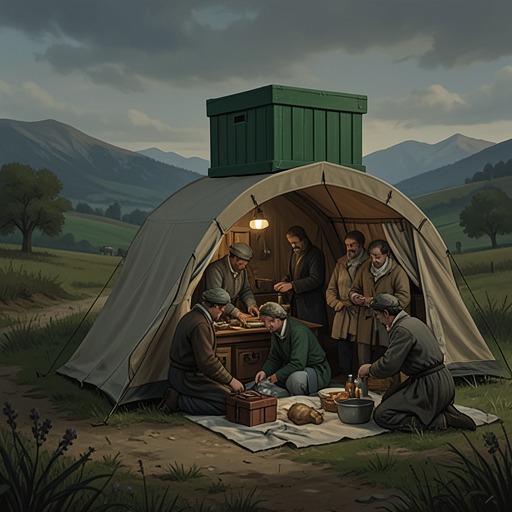
The two travel from market to market, crossing from town to town and shire to shire. Their small wheeled van is both home and vehicle; Homo draws it by day and guards it at night. When roads become rough, steep, or muddy, Ursus joins the effort, fastening the trace around his own neck and pulling beside the wolf. The arrangement makes their companionship visible in physical work: Ursus does not leave the burden to Homo when the journey becomes difficult.
They stop wherever a patch of common ground or a public gathering place offers room to camp, including woods, village outskirts, market places, and the places where roads meet. At a fair or other gathering, Ursus addresses the crowd while Homo helps attract attention and collect money with a bowl. The people’s curiosity sustains their livelihood, and the pair turn their different abilities into a shared performance. Homo’s courteous bearing and trained behavior entertain spectators; Ursus’s speech and showmanship give the act its public shape. The proceeds belong to their common means of survival, not to separate enterprises.
Reciprocal Influence and Mutual Recognition
Their relationship works in both directions. Ursus has taught Homo to stand upright, restrain his rage, and growl rather than howl. These learned behaviors make the wolf legible to human spectators and contribute to their public act. Yet Homo also changes Ursus’s understanding of how a life can be lived. From the wolf, the man learns to do without a roof, bread, and fire, and to prefer hunger in the woods to subjection in a palace. Their partnership is therefore not only the human training an animal: each acquires something from the other, and the influence of the wolf reaches into Ursus’s ideas about freedom.
Ursus expresses this closeness by regarding Homo as his analogue and a faithful copy. He imagines that someone wishing to know him after his death could study the wolf. Such confidence turns companionship into a form of self-knowledge: Homo’s habits and character seem to Ursus to preserve what he himself is. The bond does not erase the difference between man and wolf, but it unsettles any easy assumption that the human partner alone possesses intelligence, loyalty, or a capacity to teach.
Public Performance and Narrative Significance
The partnership depends on an audience, yet its private meaning exceeds the entertainment it offers. Ursus and Homo use the public’s appetite for spectacle to make a precarious living, with Homo’s tameness drawing attention and Ursus’s talk and skills sustaining the act. Their life thus joins mutual care to economic necessity: they perform because they need to eat, but the narrative also presents the performance as an expression of their affinity.
That setting provides a revealing contrast with Gwynplaine, another performer whose appearance makes spectators laugh regardless of his inward feelings. Homo’s trained conduct helps make the pair’s act intelligible as a display, while Gwynplaine’s fixed expression turns spectators’ laughter into an involuntary response to a face he cannot control. The contrast clarifies the different conditions beneath public amusement: one performance is part of a working partnership, while the other exposes the gulf between a performer’s appearance and inner life. In Ursus and Homo’s case, the lasting significance is their mutual recognition. The man does not see the wolf as merely a prop or servant; he sees in him a companion whose example has altered his own life.